
 by
by Key Takeaways
So, How Many Miles Is 10,000 Steps?
Let’s just answer the question straight.
For the average adult with a stride length of about 2.1 to 2.5 feet, 10,000 steps works out to roughly 4 to 5 miles. Most people land right around 4.7 miles when you average it out. Not quite five miles. A little more than four. That’s the honest answer.
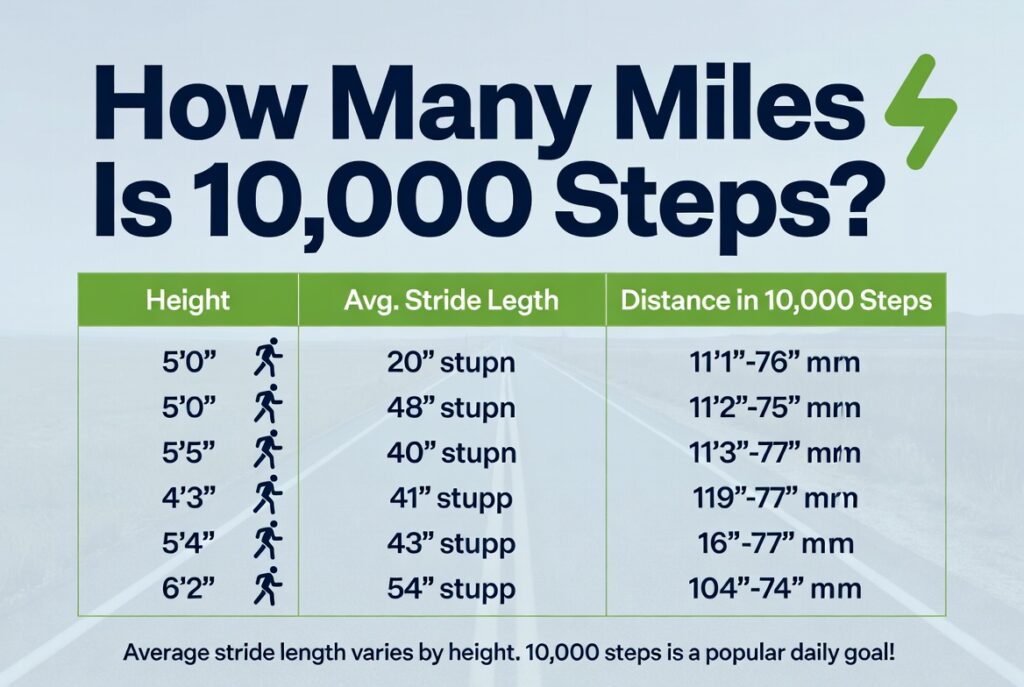
But here’s the thing — it’s not a perfect universal number. Your height changes everything. A 5’2″ woman and a 6’1″ man are not covering the same ground with the same number of steps. The taller person’s stride is longer, so they cover more distance per step. Same number of steps, more miles.
Here’s a quick breakdown:
| Height | Avg. Stride Length | 10,000 Steps Distance |
|---|---|---|
| 5’0″ | ~2.0 ft | ~3.8 miles |
| 5’3″ | ~2.1 ft | ~3.9 miles |
| 5’6″ | ~2.2 ft | ~4.2 miles |
| 5’9″ | ~2.4 ft | ~4.5 miles |
| 6’0″ | ~2.5 ft | ~4.7 miles |
| 6’2″ | ~2.6 ft | ~4.9 miles |
So if someone tall tells you they walked 10,000 steps and you’re on the shorter side — they probably covered more ground than you did on your 10,000. Not a competition. Just math.
How Many Miles Is 10,000 Steps on a Treadmill?
Good question, and one that confuses people more than it should.
On a treadmill, 10,000 steps is how many miles you cover follows the same logic as outdoor walking — your stride length determines the distance. The difference is that treadmills track distance directly on the display rather than counting steps, so the two numbers don’t always match up cleanly.
Here’s why: treadmills measure based on belt speed and time. Your fitness tracker counts steps based on arm swing and movement. These two systems don’t always agree, especially if your running form changes at higher speeds or if you hold the handrails (which shortens your stride without the tracker knowing).
A few things to keep in mind for treadmill walking:
- At a normal walking pace (3 mph), reaching 10,000 steps takes roughly 80 to 90 minutes
- At a brisk pace (3.5 to 4 mph), you hit 10,000 steps in about 60 to 75 minutes
- Incline changes your calorie burn significantly but doesn’t change step count much
- Holding the handrails reduces your actual effort — let go if you can
| Treadmill Speed | Approx. Time to Hit 10,000 Steps | Est. Distance |
|---|---|---|
| 2.5 mph (slow walk) | ~95–100 min | ~4.0 miles |
| 3.0 mph (normal walk) | ~85–90 min | ~4.2 miles |
| 3.5 mph (brisk walk) | ~70–75 min | ~4.4 miles |
| 4.0 mph (fast walk) | ~60–65 min | ~4.7 miles |
| 4.5 mph (power walk) | ~55 min | ~4.9 miles |
The treadmill display and your step counter may show slightly different numbers — that’s normal. Trust the general range and don’t stress about decimal points.
How Many Calories Do 10,000 Steps Burn?
This one varies a lot by body weight, walking speed, and terrain. But here’s a reasonable estimate:
| Body Weight | Calories Burned (10,000 Steps) |
|---|---|
| 120 lbs | ~240–300 calories |
| 150 lbs | ~300–380 calories |
| 180 lbs | ~360–450 calories |
| 200 lbs | ~400–500 calories |
| 220 lbs | ~440–550 calories |
Walking uphill, on sand, or at a faster pace pushes these numbers higher. A slow flat stroll burns less. If you’re trying to lose weight, walking alone won’t do it overnight — but it stacks up consistently over weeks and months in a way that most people underestimate.
The Science Behind 10,000 Steps — Where Did That Number Even Come From?
Here’s something most people don’t know — the 10,000 steps goal wasn’t born in a research lab. It came from a Japanese marketing campaign in 1965. A company called Yamasa Clock made a pedometer called the Manpo-kei, which translates literally to “10,000 steps meter.” The number was chosen because it sounded motivating and complete, not because a scientist ran the numbers.
That said — decades of real research have actually validated it since then.
A 2019 study published in JAMA Internal Medicine tracked nearly 17,000 older women and found that those who walked around 7,500 steps per day had significantly lower mortality rates than those who walked 2,700. The benefits leveled off around 7,500 steps — but more steps didn’t hurt.
A 2021 study in JAMA Neurology found that people who walked more had lower risks of developing dementia — even at step counts well below 10,000.
The real takeaway from the science isn’t that 10,000 is a magic number. It’s that more movement is almost always better, and 10,000 steps happens to be a goal that gets most sedentary people moving significantly more than they otherwise would.
Read Also: How Many Calories Are in an Egg
Real Health Benefits of Walking 10,000 Steps Daily
Heart Health
Walking is cardiovascular exercise — not glamorous, not intense, but genuinely effective. The American Heart Association has recommended walking as a primary strategy for improving heart health for years. Studies consistently show that regular walking lowers blood pressure, improves cholesterol levels, and reduces your risk of coronary heart disease by up to 35%.
Mental Health and Mood
This one gets overlooked. Walking triggers the release of endorphins and serotonin — your body’s natural mood regulators. A Stanford study found that walking in nature specifically reduced rumination, which is the kind of repetitive negative thinking linked to depression and anxiety. Even a 20-minute walk can measurably improve mood within the same day.
Weight Management
Walking 10,000 steps daily burns roughly 300–500 extra calories depending on your size and pace. Over a week, that’s 2,100 to 3,500 calories — which equals roughly half a pound to a full pound of fat. That’s without changing your diet. Combined with reasonable eating, the math works in your favor over time.
Blood Sugar Control
For anyone managing diabetes or pre-diabetes, walking after meals is one of the most effective tools available. Research from Diabetes Care showed that three 15-minute walks after meals lowered 24-hour blood sugar levels more effectively than one 45-minute walk in the morning. Timing matters. Walking matters more.
Bone and Joint Health
Contrary to what some people assume, walking doesn’t wear out your joints — it actually maintains them. Weight-bearing exercise like walking stimulates bone density. The Arthritis Foundation recommends walking as one of the best activities for people with joint pain because it strengthens the muscles around joints without the impact of running.
Longevity
A Harvard study tracking over 72,000 women found that walking briskly for 30 minutes a day cut the risk of heart disease nearly in half. A separate analysis in the British Journal of Sports Medicine found that regular walkers had a 20% lower risk of dying from any cause compared to sedentary people.
Just walking. That’s it.
Why Everyone Should Walk Daily — The Scientific Case
Here’s the thing nobody argues about: the human body was built to move. For most of human history, walking wasn’t a fitness goal — it was just how people got through the day. Sitting at a desk for 8 hours straight is the anomaly. Our bodies didn’t design for it.
When you stop moving regularly, things start breaking down:
- Metabolism slows — your body burns fewer calories at rest
- Insulin sensitivity drops — cells become less responsive to blood sugar regulation
- Muscle mass decreases — especially in the legs, which are the largest muscle group in the body
- Mental sharpness fades — reduced blood flow to the brain affects concentration and memory
- Sleep quality suffers — physical inactivity is directly linked to worse sleep
Walking daily reverses most of these. Not halfway. Significantly.
A study from PLOS ONE found that people who took more steps daily had measurably lower rates of obesity, diabetes, cardiovascular disease, and depression — across every age group studied, from 18 to 85. The dose-response was clear: more steps, better outcomes, almost without exception.
The World Health Organization recommends at least 150 minutes of moderate physical activity per week for adults. Walking 10,000 steps most days more than clears that bar.
Bonus Read: Calories in Popcorn
Practical Ways to Hit 10,000 Steps Without Rearranging Your Life
You don’t need a two-hour walk block in your calendar. Most people hit 10,000 steps by stacking movement throughout the day:
- Morning walk before work — even 20 minutes gets you 2,000+ steps out of the gate
- Take the stairs every time, no exceptions
- Walk during phone calls — if your hands don’t need to type, your legs can move
- Park farther away from wherever you’re going
- 10-minute walk after each meal — three meals, three short walks, maybe 3,000 steps right there
- Walk during lunch instead of scrolling
- Evening neighborhood loop before winding down — 30 minutes adds another 3,000–3,500
Most people who track their steps are surprised how close they already are on a normal day. The gap is usually just a couple thousand steps — one extra lap around the block.
Final Thought
10,000 steps is how many miles? About 4 to 5, depending on who you are. On a treadmill, the same general range applies. The math checks out.
But the number was always just a hook — a target that’s easy to remember and motivating to chase. What the science actually says is simpler: people who walk more live longer, feel better, think more clearly, and get sick less often. The specific step count matters less than the consistency.
Start where you are. Add a few hundred steps each week. Let it become automatic.
The miles take care of themselves.