
 by
by Love is an extremely beautiful feeling, and at the same time, it is one of the most difficult to describe. It is sometimes hard to say the words–you know how to feel when you say I love you, but your mouth stammers. The three words are usually hard to pronounce because of fear, vulnerability, cultural differences, or timing. In some cases, feelings are even greater than words. It is then that the Korean language is special. Korean does not depend on direct forms of love alone. Rather, it appreciates sincerity, acts, emotionality, and slow attachment. When you have ever typed i love you in Korean or asked yourself how to say i love you in Korean, you soon will find that Korean has numerous other ways of saying love, some are straightforward, others subtle, and others gracefully and indirectly.
It is crucial to have an insight into feelings before comprehending the meanings. Love is slow, quiet, and deep, which is the way it develops in the Korean culture and the words demonstrate it.
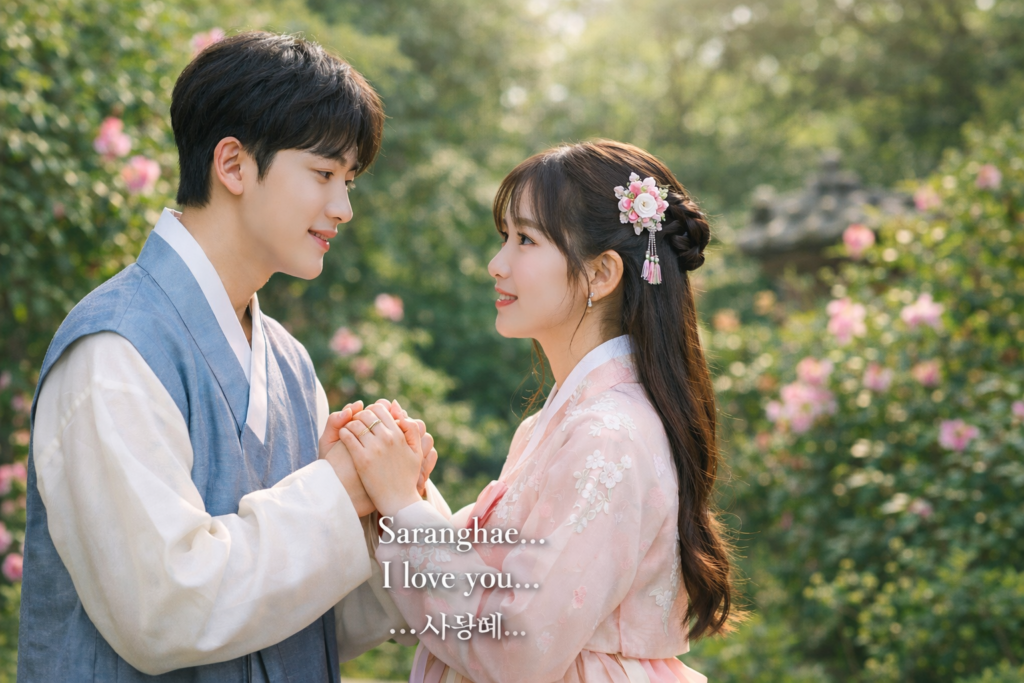
5 Ways to Say I Love You in Korean
Below are some of the most frequent and emotionally expressive phrases to convey “I love you” in Korean, presented in a clear manner for both learners and those in love.
1. 사랑해
Saranghae
“Love You”
This is casual, intimate, and commonly used between couples, close partners, or people of the same age. It feels warm and personal.
2. 사랑해요
Saranghaeyo
“I Love You“
This is the polite version and one of the most searched phrases related to saranghaeyo meaning. It shows affection while maintaining respect, making it ideal for most relationships.
3. 사랑합니다
Saranghamnida
“I Love You“
This is formal and serious. It’s often used in heartfelt confessions, speeches, or meaningful moments where emotions are deep and sincere.
4. 널 사랑해
Neol saranghae
“I Love You“
I love you (specifically you) This adds emotional focus on the person you love, making it more romantic and intentional.
5. 진심으로 사랑해요
Jinsimeuro saranghaeyo
“I love you with all my heart”.
I truly love you This expresses genuine, heartfelt love and is often used when emotions are deep and honest.
These expressions answer many people’s curiosity about korean in i love you and show that tone and context matter just as much as words.
Other Korean Expressions to Express Love

In Korea, people tend to express their love not by the spoken words but by actions and indirect language. These are not necessarily the words that should be translated to mean I love you, but in the heart they will mean everything, everything almost. Teaching how to say i love you in Korean, one should know that the language of Korean love is beyond words. Love is depicted in a caring, consistent, effortful, and emotional manner. Such words as Akkida, Joha are the stages of affection, and Saranghaeyo is a more serious devotion.
좋아해
Johae
I like you
This is commonly used in the early stages of love. Joha expresses affection without the intensity of love, making it emotionally safer.
아끼다
Akkida
To cherish or treasure
Akkida is powerful—it means caring deeply for someone, valuing them, and wanting to protect them. In many cases, it reflects love more mature than words.
보고 싶어
Bogo sipeo
I miss you
네가 있어서 행복해
Nega isseoseo haengbokhae
I’m happy because of you
항상 네 편이야
Hangsang ne pyeoniya
I’m always on your side
These expressions are frequently found in genuine relationships and Korean dramas, conveying emotional intimacy without explicitly stating I love you.
Romantic Words in Korean

To convey tenderness, passion, or romance, these Korean terms enhance the charm and richness of your loving expressions.
- 자기야 (Jagiya) – Honey / Baby
- 내 사랑 (Nae sarang) – My love
- 연인 (Yeonin) – Lover
- 운명 (Unmyeong) – Destiny
- 설레다 (Seolleda) – To feel butterflies
- 심쿵 (Simkung) – Heart-fluttering moment
- 평생 함께하고 싶어요
Pyeongsaeng hamkkehago sipeoyo
I want to be with you forever or I want to spend my whole life with you.
These affectionate phrases are often found in K-dramas and in genuine relationships, giving Korean declarations of love a lyrical and heartfelt quality.
Understanding Love Beyond Words in Korean Culture
Korean love is not a hurried affair, it is experienced, constructed, and tested. This is why when one ends up saying saranghaeyo, it is emotional and heartfelt. You may be learning Korean or may be inspired by the K-dramas or may need to find a special means to show your emotions, i love you in Korean will open the door to a deeper emotional experience. Love does not have to be loud, it simply has to be real, as taught us in the Korean language.



One thought on “Korean Language for “I Love You”: Express Love in Korean Way”
Comments are closed.